Computational Thinking in Cambridge Computer Science: Beyond Syntax
How inquiry-based learning, problem decomposition, and algorithmic reasoning transform secondary school Computer Science education.
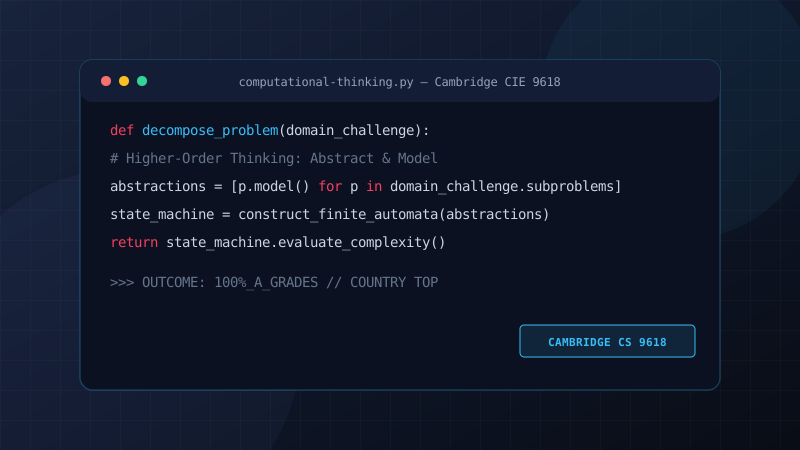
FIG // Computational Thinking in Cambridge CS Diagram
Computational Thinking in Cambridge Computer Science: Beyond Syntax
Teaching Cambridge IGCSE, AS & A Level Computer Science is frequently misconstrued as teaching code syntax. In practice, genuine subject mastery emerges not when a student memorizes the syntax of a while loop or an array method, but when they can dissect complex problems into manageable abstractions.
The Pedagogical Shift: Syntax vs. Structure
When students encounter algorithmic design in the Cambridge syllabus, the primary barrier is rarely Python or pseudocode syntax; it is problem representation.
By applying Visible Thinking Routines (VTR) and Higher-Order Thinking Skills (HOTS), we encourage learners to externalize their mental models before touching a keyboard:
- Decomposition: Breaking real-world scenarios into discrete computable subproblems.
- Pattern Recognition: Identifying recurring data structures—such as linked lists, binary trees, or state machines.
- Abstraction: Filtering out irrelevant physical constraints to construct mathematical models.
- Algorithmic Evaluation: Analyzing time and space complexity rather than merely checking whether a test case passes.
Classroom Implementation
In the classroom at Ryan Global School and Thakur School of Global Education, this approach has led to consistent subject mastery—including learners achieving Country Top honors in Computer Science.
When students treat code as the artifact of thought rather than the thought itself, their resilience in facing novel examination problems and real-world engineering challenges increases exponentially.